Multi-Generation Family Photos in Aruba: Grandparents to Grandkids
There is one sentence I hear on nearly every one of these bookings, usually from whoever organised the trip, usually about ten minutes in. Some version of: we have not all been in the same place since the wedding, and that was nine years ago.
That is what makes these different. Family photos across three generations are not really a family photoshoot in the everyday sense. They are a single hour in which grandparents, parents and grandchildren happen to be standing on the same beach, which for most families is rare enough that the rest of the trip gets arranged around it.
Worth planning properly, then. Here is how.
Why Family Photos Across Three Generations Are Not Just Bigger
People assume eighteen people is the same job as four with more faces in frame. It is not, and the reason has nothing to do with cameras.
An ordinary session has one attention span to manage. A three-generation session has two, pulling in opposite directions. The three-year-old has about twenty good minutes. The eighty-one-year-old has patience but not for standing on soft sand in the heat. Squeeze both, and you get perhaps twenty-five minutes where everyone is genuinely present and enjoying themselves. Everything below exists to protect those twenty-five minutes.
The second difference is the combinations. Grandparents alone. Grandparents with every grandchild. Each nuclear family on its own. The adult siblings without spouses. Nobody writes that list in advance, and then on the day everybody wants all of it.
Booking and Where It Falls in the Trip
Early in the holiday, not at the end. I would treat this as non-negotiable. Book day two or three, and there is room to move if weather turns, if a flight is delayed, or if someone arrives with a stomach bug, which on a trip this size is close to guaranteed.
On length, an Aruba family photoshoot of this scale needs an hour. That comfortably covers three people up to fifteen or more. Thirty-minute sessions are excellent for four people and become tight past about eight, because the combinations alone consume the time before you have photographed anyone properly.
Book further ahead than a couple would. Sunset slots in high season disappear first, and rearranging fourteen people's plans around a photographer's diary is nobody's idea of a holiday.
Choose Somewhere Everyone Can Reach
This is where planning usually goes wrong, because whoever books it chooses from photographs rather than from logistics.
The dramatic spots here, the dunes by the lighthouse, the rugged north coast, the tracks into Arikok, are genuinely beautiful and all involve uneven ground, a walk from the car and no shade. Fine for a couple. A poor decision when someone uses a stick, or there is a pushchair, or a great-grandmother is coming.
What I look for instead is a short walk from parking, firm sand near the treeline, natural shade a few steps away, and somewhere to sit down. Eagle Beach handles all of that. So do most resort beaches, and if the whole group is staying at one property, shooting on your own stretch removes the transport problem altogether, which with eighteen people is not a small saving.
Think honestly about the least mobile person in the group and plan around them. Everyone else is then fine automatically. Most of the best beach family photos Aruba produces come from ordinary accessible sand rather than the dramatic spots people pin beforehand.
Timing Around the Youngest and the Oldest
The hour before sunset gives the best light of the day and, just as importantly, the heat has dropped enough for the oldest members of the group to be comfortable. That combination is why nearly all of these get booked late afternoon.
Sunrise is the alternative and works well when there are very young children, since toddlers are at their best early and the beaches are empty. The cost is getting fourteen people up and dressed by half past six on holiday, and you know your family better than I do.
The middle of the day is the one thing to rule out entirely. Harsh overhead light, hot sand, no shade, and a group that is uncomfortable inside five minutes. Nothing in the gallery justifies it.
The Running Order
There is one correct sequence here, and it feels wrong, because it front-loads the part everyone finds tedious.
Big group first. Everyone, all three generations, inside the first ten minutes while the children are still cooperating and nobody is hot or bored. This is the frame that ends up printed in four different houses, and the only one where all eighteen people genuinely have to be present and pleasant simultaneously. Get it done and the rest of the session loosens immediately.
Then we break it apart. Grandparents alone. Grandparents with the grandchildren, which is very often the picture the whole trip was really for. Each family unit. The adult siblings together. If any of the couples want ten minutes to themselves, that folds in naturally and runs much as a couple's session would.
With the list finished, we let the children loose, and I photograph whatever happens. The way I work leans documentary, and the final fifteen minutes of a large session is usually where the gallery earns itself. Someone's father carrying a grandchild into the sea fully dressed. Two sisters laughing at something nobody else caught. None of that is on a shot list, and all of it is what people cry at later.
Clothes for Fourteen People
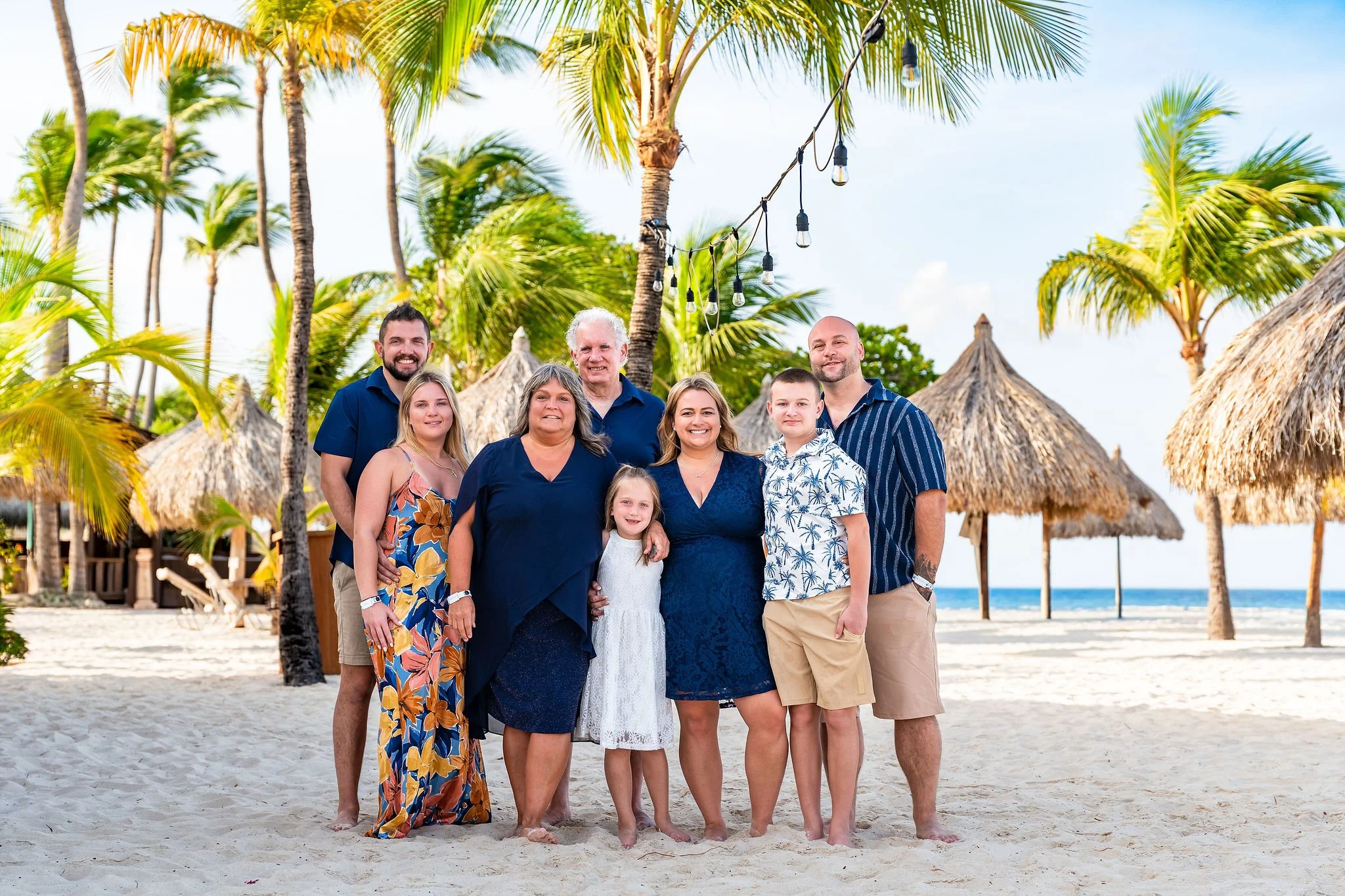
Do not try to match. Matching outfits across three generations reads as a uniform and flattens everybody into one shape.
Agree a palette instead and let people choose within it. Two or three soft colours are enough. Whites, sand tones, dusty blues, muted greens, warm neutrals. Send it to the group chat six weeks out rather than the night before, because someone will need to buy something and someone else will ignore you twice.
Three rules on top. No large logos or slogans, which grab the eye instantly. Avoid pure black, which sits heavily against bright sand. And account for the wind, since Aruba's trade wind is constant and light fabric moves beautifully where stiff fabric fights it. Long dresses and loose shirts photograph far better here than structured clothing.
Tell everyone shoes come off, too. Otherwise half the group arrives in trainers.
Small Things That Make a Large Difference
Appoint someone to be in charge, and not the photographer. No Aruba beach photographer, however experienced, can herd eighteen relatives and light a scene at the same time. You need one family member who can say quietly that it is time to leave, get people to the right beach at the right hour, and collect whoever wandered off to the bar.
Bring water. Bring a folding chair or two if anyone needs to sit between setups. Feed small children before rather than during. Keep the group out of the sun for the half hour beforehand so nobody arrives already worn out.
And settle in advance who is not being photographed. Every large family has one person who genuinely hates it, and it is far kinder to know that beforehand than to find out while eighteen people stand waiting.
Final Thoughts
Book early in the trip. Choose the location around your least mobile relative. Shoot the big group in the first ten minutes. Agree a palette rather than an outfit. Put one person in charge who is not holding a camera. That is the entire method.
If you are organising a reunion trip, send me your dates, the group size and the age range. That is all I need to tell you which beach and which hour to build the day around.
Frequently Asked Questions
How long should a session be for a large family group?
An hour once you are above roughly eight people. Thirty minutes suits a small family but gets tight when you are running the big group shot plus grandparents, grandchildren and each family unit separately. It is the number of combinations that consumes the time, not the number of faces.
What is the best time of day for beach family photos in Aruba?
The hour before sunset. The light is at its best, and the heat has dropped enough for older members of the group to stay comfortable, which matters more than people expect. Sunrise also works well when there are toddlers, since young children are at their best early and the beaches are nearly empty.
Where should we take family photos if someone has limited mobility?
Somewhere with a short walk from parking, firm sand near the treeline, shade close by and a place to sit. Eagle Beach and most resort beaches manage all of that. Avoid the dunes near the lighthouse, the rugged north coast and anything inside Arikok, which involve uneven ground and offer no shelter.
Should everyone wear matching outfits?
No. Matching across three generations tends to look like a uniform. Agree on two or three soft colours instead, such as whites, sand tones and dusty blues, and let people choose within that range. Share the palette several weeks ahead so anyone who needs to buy something has time.
When in the trip should we book our family photos?
Day two or three. Booking early leaves room to move things if the weather turns or a flight is delayed, both common on large family trips. Leaving it until the final evening means there is no second chance if anything goes wrong.