Evening Wedding Photos in Aruba After the Sun Goes Down
Almost every couple who books me asks some version of the same question, usually about three weeks before the wedding. What happens to the photos once it gets dark?
It is a fair worry. Every image they have seen of an Aruban wedding, including most of mine, is drenched in that late afternoon sun. Then they look at their timeline, notice the reception runs until eleven, and start wondering whether they have booked five hours of gorgeous photographs followed by four hours of nothing. So here is what actually happens after sunset, and how I approach wedding photography once the good light has gone.
Sunset Here Is Not a Slow Fade
This is the part that catches people out. Aruba sits at around twelve degrees north, which means the sun drops almost vertically rather than sliding sideways across the sky the way it does in Europe or the northern United States.
The practical effect is that twilight is short. In New York in June, you get a long, generous hour where everything stays soft and workable. Here you get roughly twenty to twenty-five minutes between the sun touching the horizon and the light being properly gone. Sunset itself lands somewhere between quarter past six and just after seven depending on the month, and it barely moves across the year.
So when a planner tells you there is plenty of time after the ceremony, ask them to be specific. Twenty minutes is not plenty. It is enough for one thing done well, and that thing should be the two of you.
The Twenty Minutes Nobody Plans For
Immediately after sunset, there is a window photographers call blue hour, which is a generous name for something that lasts about a third of that. The sky turns a deep cobalt, the sea holds onto colour, and any warm light around you glows against it.
It is the best light of the entire day, and almost every wedding timeline wastes it, because it falls exactly when everyone is being seated for dinner. If you do one thing with this article, do this. Build in ten minutes right after sunset where the two of you step away from the reception. Ten minutes. Your guests will not notice, and you will get frames that look nothing like the rest of the gallery.
What the First Dance Actually Needs
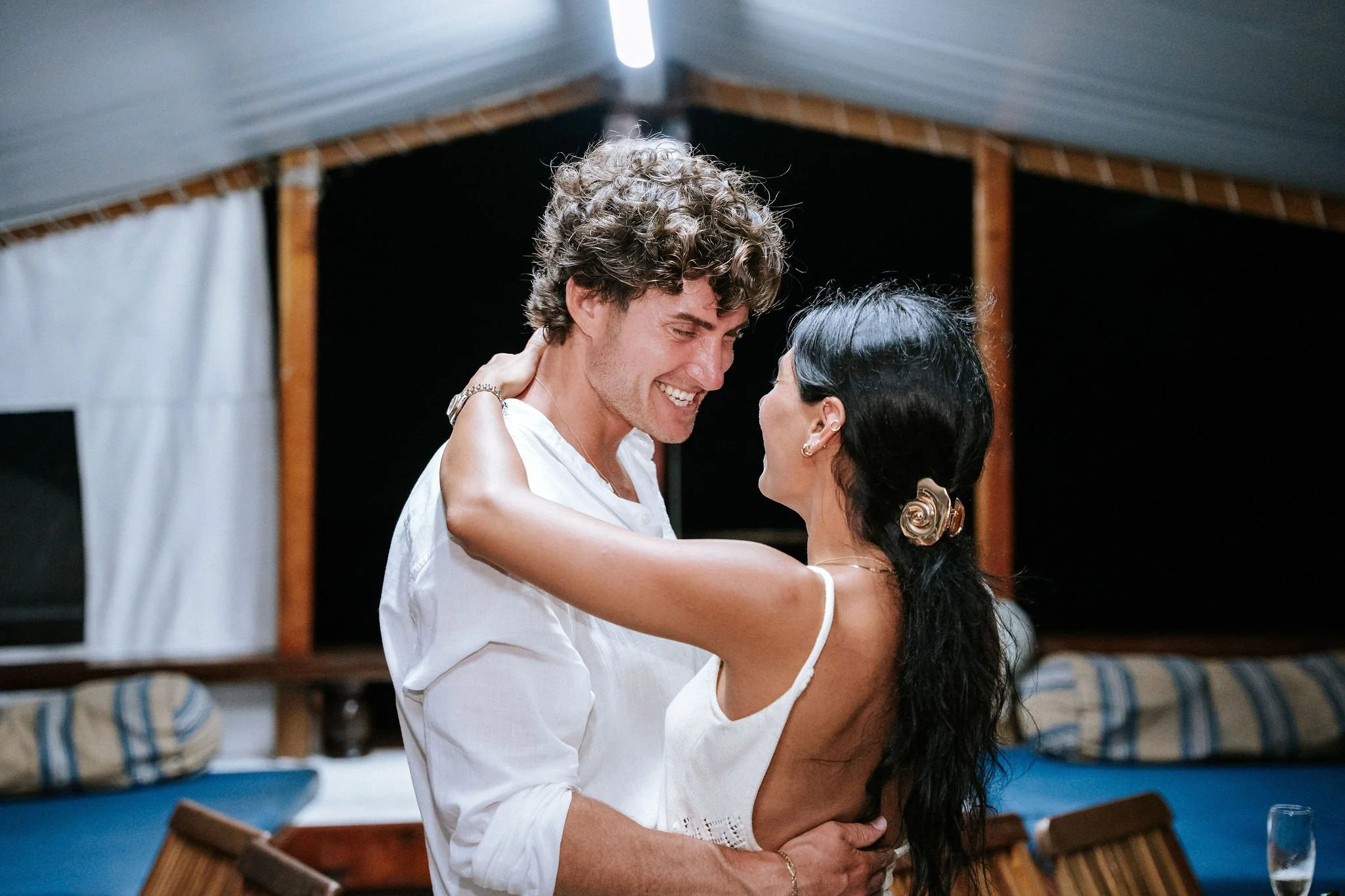
The photo at the top of this post is a first dance under a marquee, lit by a single strip light overhead. No uplighting, no fairy lights, nothing engineered for a camera. It still works, and it works because of the thing that always matters more than the lighting rig.
Two faces close together and nobody performing for anyone.
First dance photography is less about the room than people assume. What I need is a position where I can see both faces, a floor where you are not backed into a wall, and enough space to move around you while you turn. What I do not need is a lighting designer. Some of my favourite frames from receptions have come from candles, a single overhead bulb, or the glow off a marquee ceiling.
One request I make of every couple. Ask your DJ to keep the coloured LED effects off for the first dance and to bring them in afterwards. Those saturated purples and greens look brilliant in the room and turn skin tones a colour nobody wants to be in their album. Thirty seconds of conversation at the rehearsal saves the entire dance.
Reception Lighting That Helps and Lighting That Hurts
Since I get asked, here is the honest ranking from a photographer's side of the room.
String lights overhead. The single best investment you can make. Warm, even, atmospheric, and they photograph beautifully because they sit above people rather than blasting at them. If your venue offers them, take them.
Candles and hurricane lanterns. Gorgeous, and worth knowing that on this island they must be shielded. The trade wind is constant, and open flames simply will not survive on an exposed terrace. Glass around every candle, or you will have an unlit table by the second course.
Uplighting on walls or palms. Good for atmosphere, neutral for photographs. It shapes the space without doing much for faces. Keep it warm rather than coloured if you have the choice.
Coloured DJ effects and moving heads. Great for the dance floor later. Genuinely difficult during speeches and the first dance. Timing is everything here, not banning them.
Nothing at all. Also fine. This is what flash is for, and it is a normal part of the job rather than a rescue mission.
Flash, and How I Use It
There is a version of night wedding photography where the photographer stands in front of you with a flash pointed at your face and everything behind you falls into a black hole. That is the look most people picture when they imagine reception photos, and it is why they worry.
I work the other way around. I drag the shutter so the room stays visible, the string lights stay warm, and the sky keeps whatever colour is left in it, and I use flash only to lift the people. The result looks like the evening actually felt rather than like a police interview. If you want a sense of how I shoot more generally, that same instinct runs through the daylight work too.
Two practical notes from shooting here specifically. Humidity is high, and gear fogs badly when it moves from an air-conditioned room out to a warm terrace, so I bring cameras out early and let them acclimatise rather than pulling a cold lens out at the moment you walk in. And on beach receptions, sand and wind mean I keep lens changes to a minimum after dark. None of that is your problem, but it is the reason I am usually set up and standing around long before anything happens.
The Photos That Only Exist After Dark
Everything on this list is impossible before sunset, which is the argument for the evening more than anything I could say about light.
Night portraits on the sand with the resort lights behind you. Speeches, where the reactions on the faces watching are usually better than the person speaking. The moment the dancefloor tips over from polite into genuine, which is almost always around the third song. Sparkler exits, which need proper darkness to work at all and are worth asking your venue about early, since not every resort permits them.
And the quiet ones. Someone's grandmother refusing to sit down. Your best friend crying at the bar. Both of you finally getting five minutes alone at the edge of the party. If you are also having a film alongside the photos, the evening tends to produce the footage people rewatch most.
Should Your Coverage Run Past Sunset?
Not always. If you are having an intimate ceremony and a long dinner with twenty people and no dancing, ending shortly after the meal starts is a perfectly sensible decision, and I will tell you so.
But if there is a first dance, speeches, a real dance floor, or an exit, cutting coverage at sunset means paying for the setup and leaving before the payoff. The most common regret I hear is from couples who booked to the end of dinner and now have no photographs of the part of the night everyone talks about afterwards.
The middle option that works well is asking for coverage through the first dance and the opening stretch of dancing rather than the full night. You get the moments that matter and you are not paying for the last hour when the crowd has thinned. I walk through this properly with every couple as part of the wedding experience, including building the timeline itself, which is where most of these decisions actually get made.
Final Thoughts
Evening wedding photography in Aruba is not a compromise on the daylight version. It is a different set of pictures, warmer and closer and usually more emotional, because by then everybody has stopped thinking about the camera.
If you are working out where your coverage should start and stop, send me your date and the outline of your day. I will tell you honestly what I think, including if the answer is that you need less than you thought.
Frequently Asked Questions
Do wedding photos still turn out well after dark in Aruba?
Yes, and they look different rather than worse. Evening frames tend to be warmer, closer, and more emotional because guests have relaxed and stopped noticing the camera. The technique changes, since flash and slower shutter speeds come into it, but the results are every bit as good as the daylight coverage.
How long does twilight last in Aruba?
Roughly twenty to twenty-five minutes. Aruba sits close to the equator, so the sun drops almost vertically and the light goes quickly, unlike the long summer evenings further north. Sunset falls between about quarter past six and just after seven depending on the month, with very little variation across the year.
What lighting should we ask our venue for?
Warm string lights overhead are the best single addition, and candles inside glass hurricanes work beautifully as long as they are shielded from the trade wind. Coloured DJ effects are fine for the dance floor but should stay off during speeches and the first dance, since they shift skin tones in a way editing cannot fully undo.
Do you need extra lighting for the first dance?
Usually not. A single overhead light, string lights, or even candlelight is enough, and I bring my own flash for anything darker. What matters far more is floor position, so that both of your faces are visible and there is room for me to move around you as you turn.
Should we book wedding coverage until the end of the night?
It depends on your plan. For an intimate dinner with no dancing, ending soon after the meal begins is reasonable. If you are having speeches, a first dance or a proper dance floor, coverage through the first dance and the opening stretch of dancing is the option most couples are happiest with afterwards.